Tom Covello Interview
An Interview with Tom Covello
By Bobbie Newman, Jazz Arts Foundation, Lexington, Kentucky.
Lexington jazz legend Tom Covello has been integral to this region’s growth and appreciation of jazz for over 40 years. He and I have been friends since the 1980’s, and I am honored to offer some insight – in his words – into Tom’s life and influence as a musician, composer, and teacher, in Kentucky and beyond.
Growing up just outside New York City, Tom began playing the electric bass as a teenager, performing in rock bands before becoming interested in jazz. While studying with Peter Compo in New York, he enrolled at Berklee College of Music, where he studied with John Neves and Bruce Gertz. Tom received his Bachelor’s degree in 1980. Following his education, he went on to perform with a wide variety of musicians in multiple genres.
Playing on a local and regional level, Tom has opened for artists such as Hal Galper, Don Lanphere, Albert King, Marcia Ball, John Hammond, Bobby Shew and Delfeayo Marsalis. He has also shared the stage with musicians including James Williams, Don Braden, Kenwood Dennard, The Les Elgart Orchestra, Tony Joe White, J.P. Pennington of Exile, The Drifters, and The Platters. His musical experience has given him the opportunity to perform and record coast to coast with many great local, regional, and international musicians.
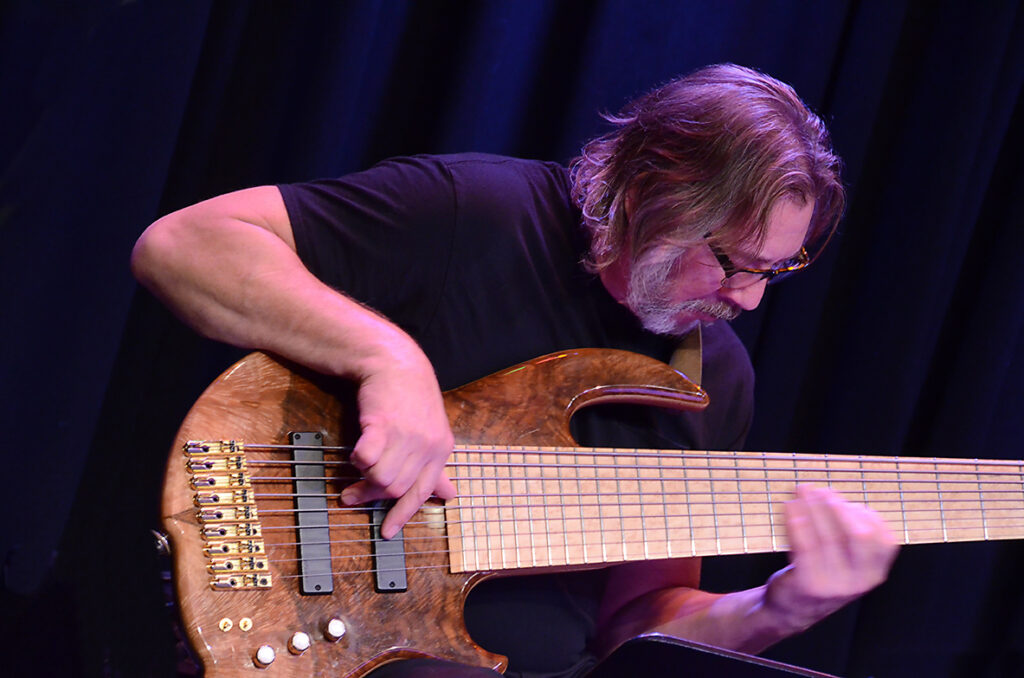
In the interest of creating a unique voice in jazz, Tom became interested in extended-range electric basses. Starting with a seven-string bass, it quickly became evident to Tom that the instrument had capabilities beyond the typical four- or five-string basses he had been playing. In addition to a new range of harmonics available, it also provided the ability to voice complex chords. With the addition of the nine-string bass, the possibilities in terms of range, voicings, and harmonics expanded even more.
Drawing from many influences, Tom holds the groove sacred and strives to complement his fellow musicians’ work with a solid foundation, whether it’s jazz, funk, R&B, blues, or classic rock. He maintains the philosophy that it’s not simply the notes you choose to play, but how you interpret the space that you put in between them.
I was delighted to have the chance recently to spend some time talking with Tom about his background, his broad range of music skills, and his diverse experience.
BN: Did music have a role as you were growing up?
TC: Absolutely. I come from a musical family – my father put himself through college playing the piano six nights a week. He also played with The Larry Kent Trio, who played the “society circuit”, which meant a lot of show tunes, Cole Porter, Gershwin, and so on. My mother taught classical ballet starting at age 16 out of her own studio. She also taught ballroom dancing and conscripted my father into playing for the classes she taught. My sister Bobbie played tenor saxophone and double bass in school, as well as piano and ukulele.
BN: So your home environment set the stage, so to speak.
TC: Yes, my father had a piano, and later a Hammond C3 organ, in our living room. When I was really little, I remember fooling around with them and liking the sounds. When I was in fifth grade, I played alto sax in the school concert band – it was my first real instrument.
But when I was in the sixth grade, my parents decided that I should be playing trombone. I guess they had Glenn Miller on their minds. So my father came home from work one day and gave me a valve trombone, why, I don’t know. But I took to it, and that’s what started me reading bass clef from an early age. I had private lessons, and I practiced two hours a day. I tried out for All County and All State Concert Bands every year; in eighth grade, I got first chair in All State, but in the baritone horn section. I was first chair in the high school concert band and also in the marching band.
Growing up near NYC in lower Westchester County allowed me to experience a lot of diversity in music. When I was 11, I wanted to play guitar because I figured I could attract more girls than with the valve trombone. I got my first electric guitar when I was 12. It cost $30, money saved up from my allowance and caddying. I started a band with some friends, but everyone wanted to play guitar, so I ended up playing the bass parts on the four lowest strings on the guitar. When I was 15, I got my first real bass, a red Guild Starfire. By then, I was playing high school dances and parties, playing Rolling Stones and Beatles songs. Then one day I heard the band Genesis on the radio, when they first came out. I immediately felt connected to them and to groups like King Crimson and Yes and Gentle Giant. The level of playing was so much more sophisticated than what I had been playing, and I was immediately drawn to it.
At 19, I joined a progressive rock band that supposedly had “connections” in LA, so all of us piled into a U-Haul and moved out there. The band leader, a cat from England, said everything was taken care of, but that wasn’t the case at all, and we all ended up living on spaghetti with ketchup as the sauce, in a two-room apartment above a bar in Burbank. Three months later, I was back in New York. One day I tuned into a station I hadn’t heard before, WRVR. They were playing jazz: Chick Corea, Weather Report, and ECM [the jazz label] artists like Eberhard Weber. On Sundays, they had Salsa Sunday, playing Eddie Palmieri, Cachao, Bobby Rodriguez, and the Fania All Stars. I had an epiphany, and that’s when I decided I wanted to really master the electric bass. I found a bass teacher and paid for my own lessons. He was a Juilliard graduate, and after a few months, he suggested I go to Berklee, from where I graduated in 1980.
BN: When did you realize music could be your career?
TC: My trombone teacher was already gearing me up to go to Eastman School of Music by the time I was 16. The material I was reading was challenging, and my parents dropped subtle hints that maybe one day I could play trombone in the Tonight Show band. But that year we moved to Upper Westchester County, and it was too far for me to continue private lessons on the trombone. Besides, the high school I was now going to had a much smaller program, which didn’t allow as much growth. I was heavily into progressive rock and really wanted to play bass professionally, but my parents discouraged me. I think they were too concerned with the drugs and general lifestyle of rock musicians that was happening in the late 60’s and early 70’s. I went to college as a chemistry major, but disliked the core classes, so I dropped out and worked for a year or so. That was when I moved to LA, came back, and had my jazz epiphany.
BN: What would you say were some of your most valuable encounters with other jazz musicians?
TC: I have to say that every encounter with other musicians, including jazz musicians, has been valuable in one way or another. There’s always an opportunity to observe and learn. But there was one experience that really changed my entire perspective, and that was when I was working with pianists/composers Bob Degen and the late Bruce Martin. Bruce was a monster keyboard player from the Northeast who had spent time playing in NYC. We did a lot of gigs at The Coach House in Lexington. I met Bob through Bruce; Bob was a major player in Germany and beyond, mostly Europe and Asia – he’s also a Berklee guy. Bruce and I had already formed The Lexington Jazz Project and asked Bob to join us. Bob had charts of some of his compositions and, as we played through them, I was introduced to an entirely new level of harmony that was both complex and intriguing. As a group, we never stopped progressing; we were always adding to and revising our repertoire.
From this, I gained the understanding of how important it is to keep moving forward and never remain complacent. If you look at composers like Miles Davis and Wayne Shorter, throughout their careers, they were constantly reinventing their material, creating entirely new identities.
BN: I appreciate you giving us this chance to learn more about the man behind the bass. Any final thoughts?
TC: Music is deeply embedded in my life, it is in my DNA, and will always be an integral part of me. It has been a healing force that has provided positive energy and has comforted me in so many ways. And I am extremely fortunate to have had the experiences that I have had: a lifetime of gigs, performing with musicians from all over the globe, and the opportunity to share my love of music with others.
BN: Thank you, Tom – we are so grateful that you share this love with us.